
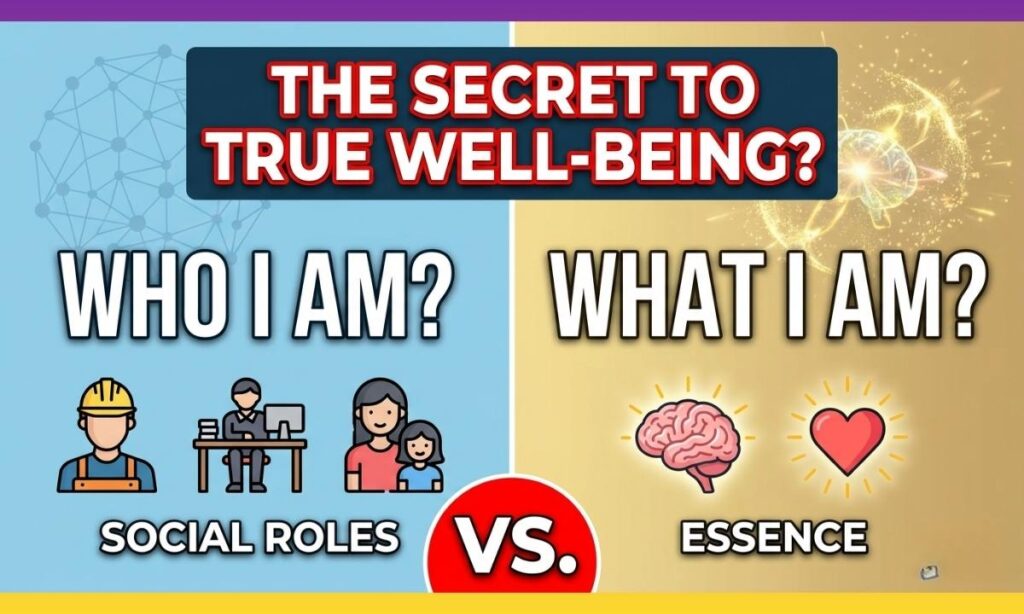
Who I Am vs. What I Am: Which Matters Most for Overall Well-being?
Life frequently presents us with two profound questions: “Who am I?” and “What am I?” While they may sound interchangeable, they point to fundamentally different dimensions of our existence. Understanding the distinction between them is essential for achieving a balanced, peaceful, and meaningful life.
Who I Am: The Self-Me
When we ask “Who am I?”, the answers are usually centered on our social identity and personal history. We identify ourselves through:
- Our names: Ramesh, Sita, or John.
- Our professions: Teacher, doctor, or entrepreneur.
- Our origins: Cultural, national, or regional heritage.
- Our roles: Parent, spouse, sibling, or friend.
- Our current state: Feeling happy, stressed, or exhausted.
These labels are essential for navigating society. Think of this identity as the cover of a book. The cover provides necessary information—the title, the author, and a glimpse of the genre—which helps others understand how to interact with us. However, the cover is not the story itself. If we define ourselves solely by these external markers, we mistake the packaging for the substance.
What I Am: The Essence of Being
When we shift the inquiry to “What am I?”, we move away from social roles and into the realm of our inner essence. This question is not about who you are in relation to others, but about your fundamental nature. It touches upon the universal consciousness, the life force that animates your body, mind, and spirit.
Opening the book reveals the story inside. When we explore “What I am,” we realize that beneath the titles and roles, we are all connected by a shared, silent, and universal energy. It is the realization that while our covers may look different, the “story” of life is a shared human experience.
Why Nature Lives in Harmony
In the natural world, other beings do not suffer from identity confusion. A tree does not label itself based on species or height, nor does it compete with a nearby bush for status. It simply fulfills its purpose: it grows, provides shade, produces oxygen, and sustains life.
Animals and plants exist in a constant state of “What they are”—direct expressions of life. They do not carry the burden of an ego that demands validation or status. Humans, however, often become trapped in the “Who,” leading to unnecessary division, comparison, and competition. When we over-identify with our social roles, we feel the weight of insecurity and conflict.
The Cinema Screen Analogy
To understand the relationship between these two concepts, consider a cinema hall. The movie playing on the screen—filled with drama, laughter, and tragedy—represents “Who I am,” your shifting roles and emotions.
However, the movie cannot exist without the screen. The screen is “What I am”—the silent, unchanging consciousness that allows the drama to play out. If you focus only on the movie, you will be swept away by its highs and lows. If you remember the screen, you maintain a sense of calm, knowing that your core essence remains untouched by the external events of the day.
Why “What I Am” Matters Most
While “Who” helps us function in the world, “What” provides the foundation for genuine well-being.
- Roots vs. Branches: A tree with heavy branches but weak roots will eventually topple. Your social roles (Who) are the branches, while your deeper consciousness (What) is the root system.
- The Ocean vs. The Waves: Your identity (Who) is like the waves on the surface, which are constantly rising and falling. Your essence (What) is the ocean—vast, deep, and stable. True well-being is found by connecting with the ocean, not just chasing the waves.
Practical Reflections for Daily Life
You can integrate this balance into your daily routine with three simple reflections:
- The Morning Check-in: As you look in the mirror, ask yourself, “Who am I playing as today, and what is the underlying energy fueling this day?”
- During Moments of Conflict: When you feel a strong reaction to a person or situation, pause and ask, “Am I reacting from my limited social identity, or can I respond from a place of deeper awareness?”
- Before Sleep: Reflect on whether you lived your day solely through your roles or if you managed to connect with your broader, more peaceful sense of self.
Conclusion: Achieving Wholeness
Ultimately, both questions are necessary. We need “Who” to take responsibility and contribute to our community, but we need “What” to maintain inner peace and emotional stability. By realizing that you are much more than your job title or your social status, you can move through life with more compassion, less stress, and a deeper sense of fulfillment.
You are not just the movie; you are the screen that holds it all.