How to Stop Negative Thoughts Permanently? Understanding the Real Cause Behind Overthinking
Have you ever wondered why negative thoughts keep coming back even when you try your best to stay positive? One day you feel motivated, and the next day your mind is filled with fear, anxiety, guilt, comparison, or overthinking. Many people spend years trying to silence their thoughts, but the real solution may not be to stop thinking at all.
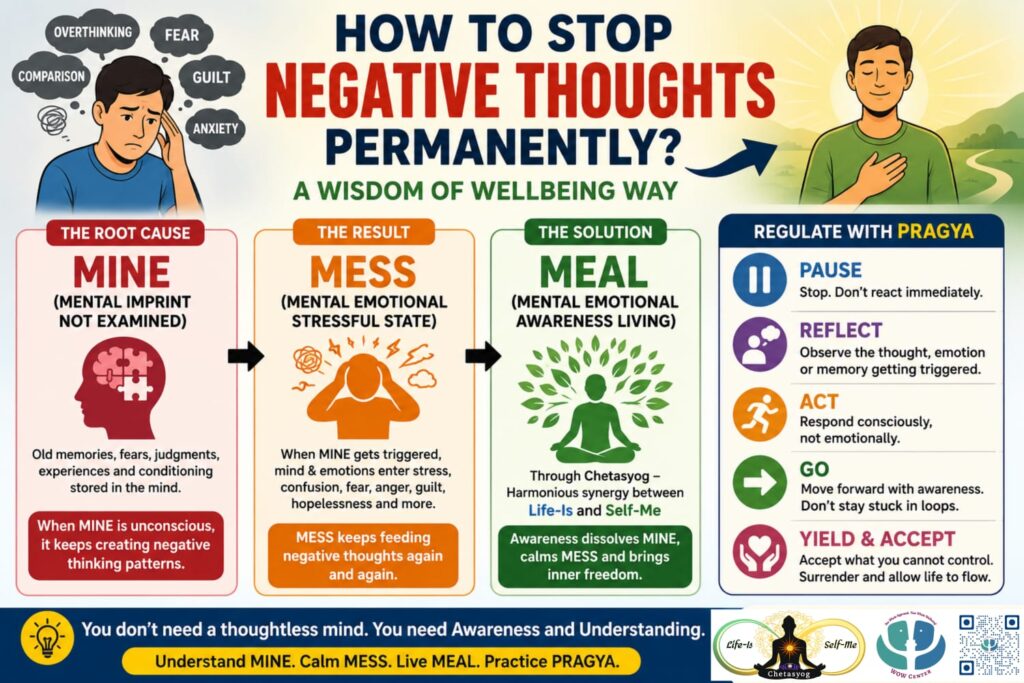
The image above presents a simple yet powerful perspective: negative thoughts are often not the problem themselves. They are symptoms of something deeper happening within us.
Highlights
- Negative thoughts are usually symptoms, not the root cause.
- Old memories, fears, judgments, and conditioning create unconscious mental patterns.
- These patterns trigger emotional stress and mental confusion.
- Awareness helps break the cycle of overthinking and negativity.
- The PRAGYA method offers a practical way to respond consciously.
The Root Cause: MINE (Mental Imprint Not Examined)
According to the framework shown in the image, the real source of recurring negative thinking is something called MINE (Mental Imprint Not Examined).
Throughout life, we collect experiences, beliefs, fears, judgments, disappointments, and emotional memories. These impressions get stored in the mind, often without our awareness. Over time, they become automatic mental patterns.
When these hidden patterns remain unexamined, they quietly influence how we think, feel, and react to situations. A simple comment from someone, a failure, or even a social media post can trigger these stored impressions.
Examples of Mental Imprints
- Fear of failure from past experiences.
- Comparison learned during childhood.
- Guilt from unresolved mistakes.
- Anxiety created by uncertainty about the future.
- Judgments absorbed from society and family.
The Result: MESS (Mental Emotional Stressful State)
When an unexamined mental imprint gets triggered, it creates what the image calls MESS (Mental Emotional Stressful State).
This is the state where the mind becomes overwhelmed by emotions such as fear, anger, guilt, confusion, frustration, hopelessness, or anxiety. At this stage, negative thoughts seem uncontrollable because the emotional system is already activated.
Most people try to fight these thoughts directly. However, the more they resist them, the stronger the cycle becomes. The MESS keeps feeding itself, creating repetitive loops of worry and overthinking.
The Solution: MEAL (Mental Emotional Awareness Living)
Instead of suppressing thoughts, the image suggests cultivating MEAL (Mental Emotional Awareness Living).
Awareness allows us to recognize what is happening inside us without immediately reacting. When we become aware of our emotions, triggers, and thought patterns, we create space between the trigger and our response.
Awareness does not mean becoming thoughtless. It means understanding why certain thoughts arise and learning how to respond consciously rather than emotionally.
Benefits of Awareness
- Reduced emotional reactivity.
- Better self-understanding.
- Improved emotional balance.
- Less overthinking and anxiety.
- Greater inner peace and clarity.
The PRAGYA Method: A Practical Approach
The image introduces a simple process called PRAGYA that can help manage negative thoughts more effectively.
1. Pause
Stop for a moment. Avoid reacting immediately. Give yourself time to observe what is happening internally.
2. Reflect
Ask yourself what thought, memory, fear, or emotion has been triggered. Try to understand the root cause rather than focusing only on the surface reaction.
3. Act
Respond consciously instead of reacting emotionally. Choose actions that align with your values and long-term wellbeing.
4. Go
Move forward with awareness. Do not remain trapped in repetitive thought loops or emotional patterns.
5. Yield and Accept
Accept what cannot be controlled. Sometimes peace comes not from changing reality but from changing our relationship with it.
You Don't Need a Thoughtless Mind
One of the most important messages from this framework is that the goal is not to eliminate thoughts completely. The human mind naturally thinks. Trying to stop every thought often creates more frustration.
What truly helps is developing awareness and understanding. When we understand our hidden mental imprints, emotional stress loses its power over us. We become capable of observing thoughts without being controlled by them.
Final Thoughts
Negative thoughts are often signs that something deeper needs attention. Instead of fighting the mind, we can learn to understand it. By recognizing our mental imprints (MINE), calming emotional stress (MESS), and practicing awareness (MEAL), we can gradually build a healthier relationship with our thoughts.
The path to inner peace may not lie in controlling every thought, but in becoming aware of the patterns that create them. Awareness brings clarity, and clarity brings freedom.