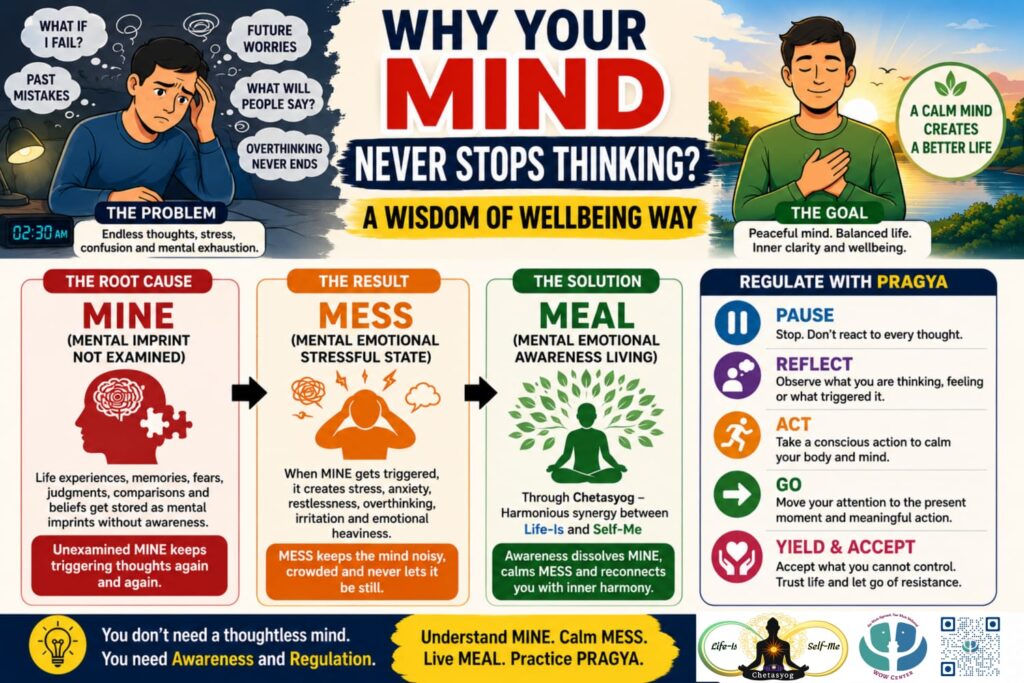
Why Your Mind Never Stops Thinking: The Hidden Root of Overthinking and How to Find Inner Peace
Have you ever found yourself replaying old conversations, worrying about future events, or imagining worst-case scenarios late at night?
Many people assume that overthinking itself is the problem. But what if overthinking is only a symptom of something deeper?
The Real Problem Isn't Thinking
Thinking is a natural and necessary function of the human mind. We need thoughts to learn, solve problems, make decisions, and plan our future.
The challenge begins when thinking becomes repetitive, emotionally draining, and impossible to switch off.
Common Signs of Overthinking
- Constant worry about the future
- Replaying past mistakes
- Difficulty sleeping
- Mental exhaustion
- Anxiety and stress
- Fear of judgment
- Lack of focus
Understanding MINE: The Root Cause
According to the framework shown in the image, the root cause of excessive thinking is MINE (Mental Imprint Not Examined).
MINE represents all the experiences, beliefs, fears, memories, and emotional conditioning stored within us without conscious examination.
Examples of Mental Imprints
- Childhood criticism
- Past failures
- Fear of rejection
- Social comparisons
- Negative self-beliefs
- Traumatic experiences
- Judgments from others
These hidden mental imprints continue influencing our thoughts, emotions, and behaviors long after the original experience has passed.
How MINE Creates MESS
When these mental imprints are triggered, they create what the framework calls MESS (Mental Emotional Stressful State).
This is the state where the mind becomes noisy, restless, and overwhelmed.
Symptoms of MESS
- Anxiety
- Restlessness
- Emotional heaviness
- Overthinking
- Fear and insecurity
- Irritability
- Mental fatigue
| Trigger | Result |
|---|---|
| Past Failure | Fear of trying again |
| Criticism | Overanalyzing every action |
| Rejection | Self-doubt and insecurity |
| Uncertainty | Future-focused anxiety |
Why Positive Thinking Alone Doesn't Work
Many people try to overcome overthinking by forcing positive thoughts. While positivity can help, it often doesn't address the underlying mental imprint.
If the root cause remains untouched, the same patterns continue repeating.
The Solution: MEAL
The framework proposes MEAL (Mental Emotional Awareness Living) as the solution.
Awareness allows us to recognize thoughts, emotions, and triggers without becoming trapped in them.
Benefits of Awareness
- Greater emotional clarity
- Reduced anxiety
- Improved decision-making
- Better relationships
- More inner peace
- Healthier responses to stress
The PRAGYA Method for Mental Regulation
1. Pause
Stop reacting immediately to every thought. Create space between the thought and your response.
2. Reflect
Observe what you are thinking and feeling. Identify possible triggers and patterns.
3. Act
Take conscious action such as deep breathing, journaling, meditation, or physical movement.
4. Go to the Present Moment
Bring your attention back to what is happening right now instead of living in past regrets or future worries.
5. Yield and Accept
Accept what cannot be controlled. Let go of unnecessary resistance and trust the process of life.
Signs You're Moving From MESS to MEAL
- Fewer repetitive thoughts
- Better emotional control
- Improved sleep quality
- Greater focus and productivity
- Less anxiety and stress
- More self-awareness
- Increased inner peace
Final Thoughts
If your mind never seems to stop thinking, remember that thoughts are often symptoms of deeper emotional patterns.
When MINE remains unexamined, it creates MESS. Through awareness and conscious living, you can move toward MEAL, a state of greater emotional balance and inner harmony.
Conclusion
You don't need a thoughtless mind. You need awareness, emotional regulation, and the willingness to understand the hidden patterns behind your thoughts. Real peace comes not from controlling every thought but from understanding yourself more deeply.