
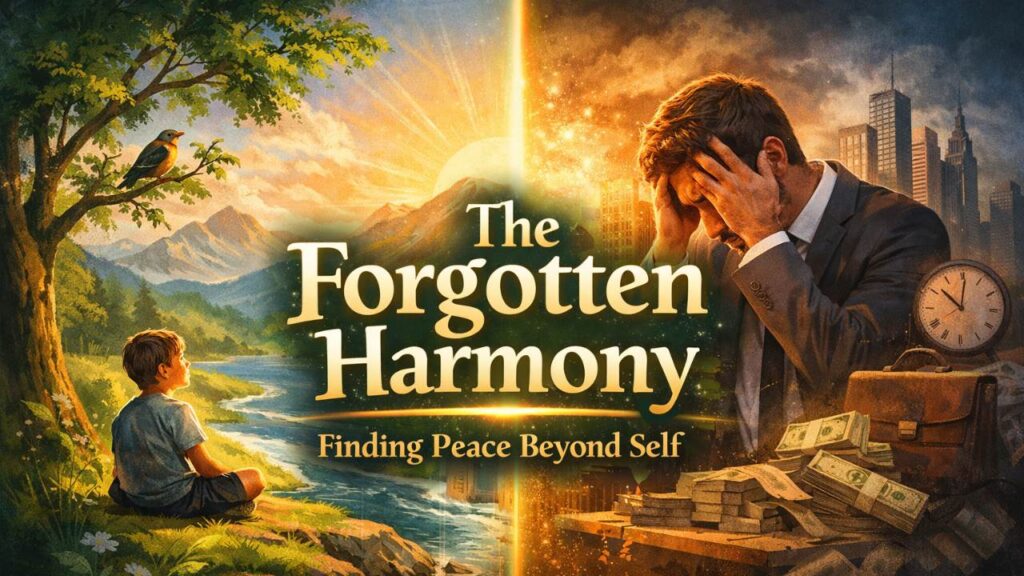
The Forgotten Harmony: Why Humans Lose Peace and How to Reconnect with Life-Is and Self-Me
Introduction
Why do humans experience stress, anxiety, comparison, and emotional struggle while nature seems to live in balance?
Birds sing without worrying about tomorrow. Trees grow without comparing themselves to others. Animals live in the present moment with ease. Yet human beings often feel trapped in fear, pressure, and endless mental noise.
This is the story of The Forgotten Harmony — a journey that explains why humans lose their natural peace and how they can reconnect with it through the understanding of Life-Is and Self-Me.
The Question That Changed Everything
Aarav was a young boy who loved observing nature. He noticed that animals, birds, rivers, and trees all seemed to move in a natural rhythm.
But people around him were different.
They worried about money.
They compared themselves to others.
They chased success and feared failure.
One night, Aarav looked at the stars and asked:
Why do humans live in disharmony while nature lives in peace?
That question stayed with him throughout his life.
We Are Born in Natural Harmony
Aarav’s grandfather once told him:
Every child is born peaceful. A baby lives naturally in the present moment. It does not compare itself with others. It does not worry about status, wealth, or future success.
At birth, Life-Is and Self-Me exist together in balance.
- Life-Is represents the natural flow of existence, awareness, and universal intelligence.
- Self-Me represents personal identity, individuality, and human experience.
When these two remain connected, life feels natural and joyful.
But over time, that harmony is forgotten.
How Society Creates Stress and False Identity
As Aarav grew older, he heard the same messages many children hear:
You must come first.
You need to be successful.
Look at others doing better than you.
Without money, life has no value.
These beliefs slowly create a false identity.
Instead of living naturally, people begin to believe their worth depends on achievement, comparison, and approval.
This is where inner conflict begins.
Nature never struggles this way.
A tree does not compete with another tree.
A bird does not feel inferior to another bird.
But humans are trained to compare and compete.
Why Humans Get Trapped in Past and Future
At eighteen, Aarav’s mind became filled with regret and worry.
He thought:
I should have worked harder.
What if I fail?
What will happen to my future?
One day, while sitting near a river, he watched fish moving effortlessly in water.
They were not worried about yesterday.
They were not anxious about tomorrow.
They simply lived in the present.
Aarav realized an important truth:
Life-Is exists in the present moment. Self-Me often lives in past memories and future fears.
This mental time-trap creates stress.
The Illusion of Control
As an adult, Aarav worked hard to control every part of life.
He wanted to control:
- Career success
- Relationships
- Reputation
- Finances
- Health
But life did not always cooperate.
He faced illness.
A close friend betrayed him.
A major project failed.
He then understood:
Humans try to control everything, but life moves in its own rhythm.
Trees lose leaves when seasons change.
Birds migrate when it is time.
Nature flows with change.
Humans suffer when they resist it.
Comparison and Competition Destroy Peace
By the age of thirty, Aarav saw friends buying homes, cars, and luxury items.
He began asking:
Am I behind in life?
Why are others ahead of me?
When will I reach that level?
Comparison creates competition.
Competition creates pressure.
Pressure creates burnout.
Many people spend years running after goals without ever feeling fulfilled.
This is one of the biggest causes of modern unhappiness.
Why Material Success Feels Empty
Aarav eventually earned money and bought many things.
He purchased:
- Expensive gadgets
- Branded clothes
- Vacations
- Comfort and convenience
Yet something still felt missing.
His grandmother told him:
External things can fill your house, but they cannot fill inner emptiness.
This is why many successful people still feel restless.
Without inner connection, outer achievement is never enough.
Overthinking and Mental Noise
At forty, Aarav’s mind was constantly active.
He worried about work.
He worried about family.
He worried about investments and future security.
Even at night, his thoughts would not stop.
Then he looked at his dog sleeping peacefully nearby.
Animals rest naturally. Humans often create endless mental noise.
The more Self-Me overthinks, the more peace disappears.
Ego and Social Roles
As Aarav gained status, he became identified with many roles:
Manager
Father
Husband
Successful person
With these identities came ego.
He began thinking:
I am important.
I know better.
I must protect my image.
But ego always creates fear.
Fear of losing status.
Fear of failure.
Fear of rejection.
The more people cling to identity, the more fragile they feel.
Fear of Death and Existential Anxiety
At fifty, Aarav began fearing death.
He wondered:
What happens after life ends?
Will I still exist?
How can I protect myself from the unknown?
Then he watched leaves fall from a tree.
They returned to the earth quietly and became part of new life.
Nature accepts endings. Humans often resist them.
Fear of death becomes smaller when we understand that life is a continuous flow.
Outer Religion vs Inner Awareness
To find peace, Aarav turned to rituals and external practices.
But inner anxiety remained.
One day, a wise teacher told him:
What you seek outside already exists within you.
That message transformed him.
Real peace does not come from external dependence. It comes from awareness.
The Turning Point: Chetasyog
Later in life, Aarav discovered Chetasyog.
Chetasyog did not ask for blind belief or ritual.
It simply guided him to observe life directly through awareness.
He began noticing:
- Breath
- Heartbeat
- Silence
- Nature
- Relationships
- Presence in each moment
Slowly, his mind became calmer.
Fear reduced.
Comparison faded.
Peace returned.
Why Humans Lose Harmony
Most inner suffering comes from these patterns:
- Ego identity
- Social conditioning
- Living in past and future
- Need to control everything
- Comparison with others
- Material obsession
- Overthinking
- Fear of death
- Dependence on external validation
- Disconnection from nature
- Emotional baggage
- Lack of self-awareness
How to Reconnect with Inner Peace
Harmony can return when we:
- Live more in the present moment
- Observe thoughts without attachment
- Reduce comparison
- Accept uncertainty
- Simplify desires
- Spend time in nature
- Become aware of breath and body
- Understand our deeper nature
Final Reflection
The story of Aarav is the story of many human beings.
We are born peaceful.
We lose ourselves in pressure and noise.
Then we spend life searching for what was always within.
Life-Is is the deeper flow of existence.
Self-Me is the human experience.
When they move together, peace returns.
That forgotten harmony is still available to every human being.