
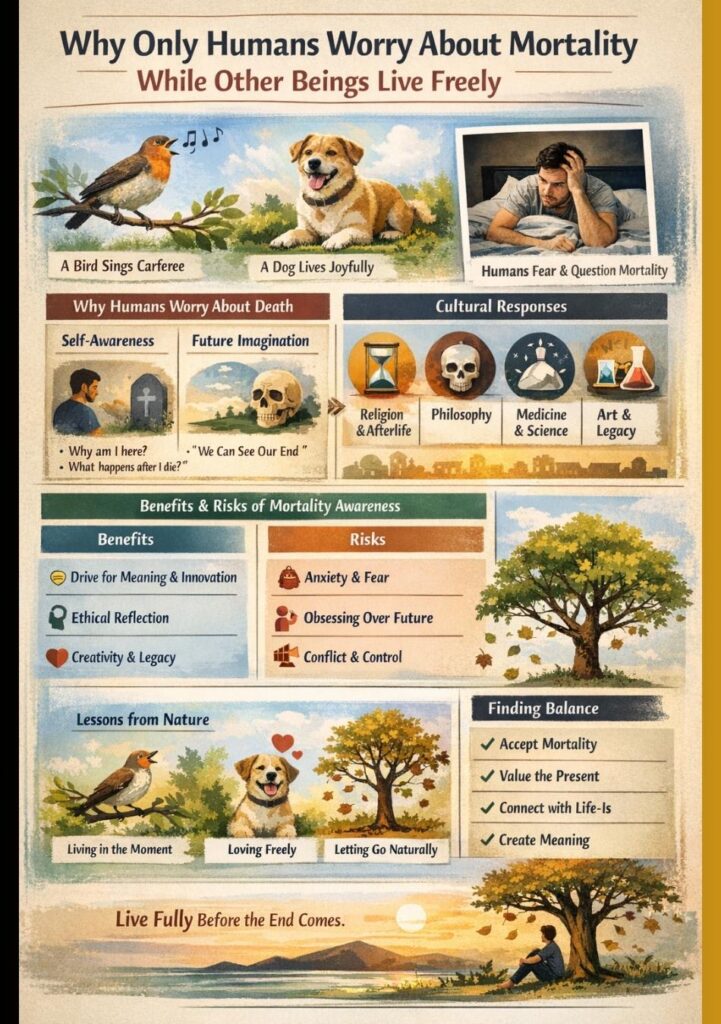
Why Only Humans Worry About Mortality While Other Beings Live Freely
Death is the one certainty of life. Every living being that is born will one day die. Birds, animals, trees, and humans all share this natural reality. Yet there is one striking difference: most creatures continue living naturally, while humans often spend years worrying about death.
A bird sings without thinking about the end of its life. A dog plays joyfully without questioning what happens after death. A tree grows steadily without fear of the day it may fall. Humans, however, often lose sleep, build philosophies, create religions, advance medicine, and search endlessly for ways to delay or understand mortality.
So why do only humans worry so deeply about mortality while other beings seem to live freely? The answer lies in human consciousness, imagination, and our need for meaning.
Human Self-Awareness Creates Mortality Anxiety
Animals and plants are deeply connected to the present moment. Their awareness is focused on survival, growth, movement, rest, and reproduction. They respond to life as it happens.
Humans possess something more complex: self-awareness.
We do not simply live life; we think about life itself. We ask questions such as:
- Why am I here?
- What happens after death?
- What is the purpose of life?
- Can death be avoided?
This self-awareness gives humanity extraordinary abilities. It allows us to create art, science, technology, relationships, and civilizations. But it also makes us aware that our lives are temporary.
That awareness can become a source of fear.
Humans Imagine the Future and Fear the End
One reason humans worry about mortality is our ability to imagine the future.
Most living beings operate largely in the present. Humans can revisit the past, analyze the present, and imagine many possible futures. This ability helps us plan careers, build homes, raise families, and create societies.
But it also allows us to imagine sickness, aging, loss, and death long before they happen.
The mind can suffer from events that have not yet arrived. This is why mortality anxiety often exists even when life is going well.
How Mortality Shaped Human Civilization
Human awareness of death has influenced nearly every part of civilization.
Because of mortality, humans created:
Religion and Spiritual Beliefs
Many traditions offer ideas about heaven, rebirth, salvation, or the continuation of consciousness. These beliefs help people face uncertainty and loss.
Philosophy
Thinkers across history have explored how to live meaningfully in the face of death.
Medicine and Science
The fear of death inspired efforts to cure disease, reduce suffering, and extend life expectancy.
Art and Legacy
People write books, paint, compose music, and build monuments so that something remains after they are gone.
Mortality has been one of humanity’s greatest motivators.
Benefits of Human Awareness of Mortality
Although worrying about death can be painful, awareness of mortality has also created many positive outcomes.
Motivation to Live Meaningfully
Knowing life is limited encourages people to seek purpose, love deeply, and use time wisely.
Innovation and Progress
Many medical breakthroughs and scientific discoveries emerged from the desire to protect life.
Ethical Reflection
When people realize time is limited, they often think more seriously about how they treat others and what legacy they leave behind.
Creativity
Artists, writers, and creators often produce meaningful work because they know life is temporary.
The Downsides of Mortality Obsession
When fear of death becomes excessive, it creates suffering.
Anxiety and Stress
Constant worry about aging, illness, or death can damage mental health.
Missing the Present Moment
Many people become so focused on protecting the future that they forget to enjoy today.
Manipulation Through Fear
Throughout history, fear of death has sometimes been used for control, profit, or power.
Conflict and Division
Some conflicts arise from beliefs about afterlife, salvation, or immortality.
What Humans Can Learn from Nature
Other living beings may not think like humans, but they demonstrate something valuable: presence.
Birds sing each morning.
Dogs offer love freely.
Trees let go of leaves and grow again.
Nature reminds us that life is meant to be lived, not only analyzed.
Humans cannot become unconscious of mortality, but we can learn balance. We can remember the future without abandoning the present.
A Chetasyog Perspective: Self-Me and Life-Is
From the Chetasyog perspective, mortality fear comes from imbalance between Self-Me and Life-Is.
Self-Me
This is the personal identity that feels separate, individual, and temporary. Self-Me fears loss and death.
Life-Is
This is the larger flow of existence. It represents the ongoing movement of life beyond any one person.
When a person identifies only with Self-Me, mortality feels terrifying. When one connects with Life-Is, death becomes part of a larger process rather than a personal failure.
Like a wave fearing disappearance, we forget that the wave is also the ocean.
How to Live Peacefully With Mortality
Instead of trying to escape death, humans can learn to live more fully.
- Accept that mortality is natural
- Use awareness of death to value time
- Focus on meaningful relationships
- Create something worthwhile
- Practice presence each day
- Balance personal goals with connection to life itself
Conclusion
Why do only humans worry about mortality? Because humans possess self-awareness, memory, imagination, and the need for meaning. These gifts create science, art, morality, and progress, but they also create fear.
The answer is not to suppress thoughts of death. The answer is to integrate them wisely.
Live with the awareness of mortality, but do not let it steal your life.
Watch a bird sing. Observe a tree standing calmly. Notice a child laughing freely.
Life is not about defeating death. It is about living deeply before it arrives.