
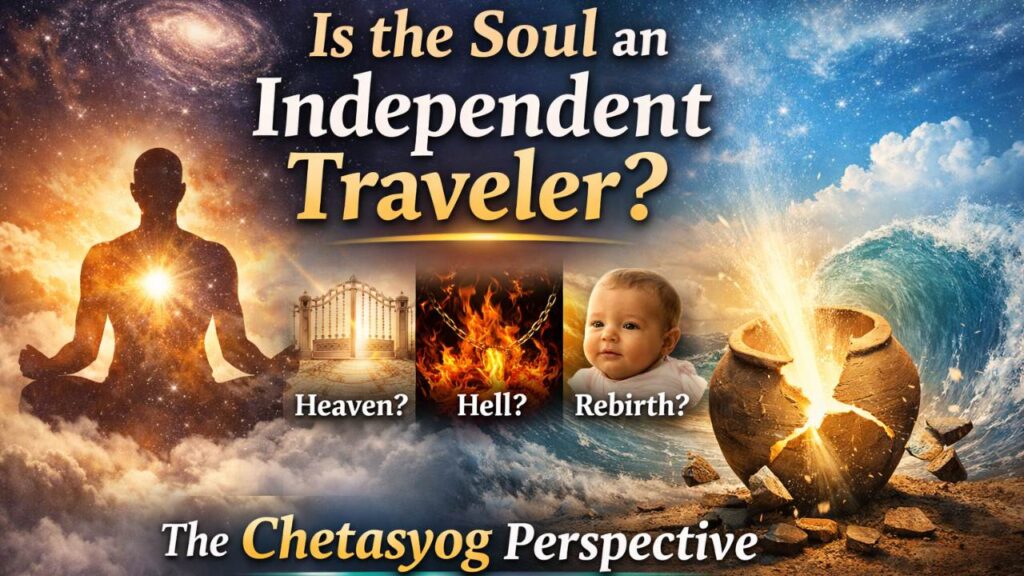
Is the Soul an Independent Traveler? The Chetasyog Perspective on Soul, Heaven, Hell, and Rebirth
Since ancient times, human beings have asked one of life’s deepest questions: What happens after death? Across cultures, stories emerged about the soul, heaven, hell, and rebirth. Many of us grew up hearing that if we do good deeds, we go to heaven. If we do wrong, we suffer in hell. And if our journey is unfinished, we are born again.
These beliefs have shaped civilizations for centuries. They have offered comfort, guidance, morality, and sometimes fear. But is the soul really an independent traveler moving from one destination to another?
Chetasyog offers a fresh and thought-provoking perspective.
According to Chetasyog, what we call the individual soul is not a separate traveler. Instead, what appears as the individual self is actually a temporary expression of a larger universal consciousness called Life-Is.
When the body ends, Life-Is continues, but not as a separate personal identity carrying memories, rewards, punishments, or baggage.
Let us explore this idea through simple analogies and practical understanding.
The Clay Pot and the Sky
Imagine a clay pot. Inside the pot is space. Outside the pot is also space.
A person may say, “This is the space inside my pot.” Another may say, “That is the space inside your pot.” But when the pot breaks, does the space inside fly away somewhere else?
No.
The space was never trapped. It was always part of the vast sky.
Chetasyog explains that the body is like the pot, and consciousness is like space. The body gives the illusion of separation, but consciousness itself remains whole and limitless.
Popular Belief vs Chetasyog View
Popular Belief
- The soul is an independent being.
- It performs good and bad deeds.
- After death, it goes to heaven, hell, or another birth.
Chetasyog View
- The personal self is not separate from universal consciousness.
- Life expresses itself temporarily through each human being.
- When the form dissolves, consciousness remains as Life-Is.
This shift changes how we approach life. Instead of living in fear of judgment after death, we focus on harmony in the present moment.
The Wave and the Ocean
Think about waves in the ocean.
Every wave has its own shape, size, speed, and movement. From a distance, each wave looks separate. But in truth, every wave is made of the same water.
A wave is not separate from the ocean.
In the same way:
- Self-Me is the wave.
- Life-Is is the ocean.
When a wave disappears, it does not travel to another ocean. It simply returns to the source it always was.
The Mirror and Reflections
Imagine a mirror reflecting many faces.
If one person walks away, the reflection disappears. But does the mirror lose anything?
No. The mirror remains complete.
Chetasyog suggests that our personal identity is like a reflection in the mirror of consciousness. Reflections come and go, but the mirror remains unchanged.
What About Heaven, Hell, and Rebirth?
Many people wonder why so many traditions speak about heaven, hell, and rebirth.
Chetasyog interprets these not as physical destinations, but as symbolic states of awareness.
Heaven
A state of inner harmony, peace, love, and alignment with life.
Hell
A state of suffering, guilt, conflict, fear, and disconnection.
Rebirth
The repetition of patterns, habits, fears, and desires until awareness awakens.
In this sense, heaven and hell are experienced in daily life, not only after death.
Why This Perspective Can Free Us
1. Freedom from Fear
Many people carry fear about punishment after death.
Chetasyog teaches that life is not a courtroom. It is an unfolding flow of consciousness.
2. Responsibility in the Present
If heaven and hell are states experienced now, then how we think, act, and relate today becomes deeply important.
3. Natural Compassion
If all beings are expressions of the same Life-Is, then harming another is harming oneself. This awareness naturally creates empathy and kindness.
The Candle Flame Analogy
Imagine one candle lighting another, and then another.
Is the same flame traveling from candle to candle?
Not exactly.
It is fire expressing itself through many wicks.
Likewise, Chetasyog suggests that consciousness is not one personal soul moving body to body, but universal life expressing through many forms.
Living With Awareness Today
When we stop seeing ourselves as isolated travelers, life becomes lighter.
We stop obsessing over future heavens.
We stop fearing eternal punishment.
We begin living more fully, lovingly, and consciously now.
This is the heart of Chetasyog: the balance between Self-Me and Life-Is.
Everyday Examples of Life-Is
A Mother’s Love
When a mother cares for her child deeply, it is not just personal emotion. It is life expressing nurture.
An Artist Creating
When an artist creates beauty with passion, it is life expressing creativity.
A Tree Giving Shade
A tree does not think about reward. It simply gives. That too is Life-Is in form.
Conclusion: The Soul Is Not a Passenger
Many imagine the soul as a passenger on a journey through heaven, hell, and rebirth.
Chetasyog offers another possibility.
The individual self is not separate from life. It is life appearing temporarily in human form.
Like a wave in the ocean, space in a pot, or a reflection in a mirror, the form may end, but the source remains.
Instead of asking, “Where will my soul go after death?” perhaps a deeper question is:
How can I live in harmony with Life-Is right now?
That question transforms life in the present.
Frequently Asked Questions
What is the Chetasyog view of the soul?
Chetasyog teaches that the soul is not a separate individual traveler, but a temporary expression of universal consciousness called Life-Is.
Does Chetasyog believe in heaven and hell?
Chetasyog sees heaven and hell as inner states of harmony or suffering rather than physical places.
What does rebirth mean in Chetasyog?
Rebirth refers to repeating mental and emotional patterns until awareness breaks the cycle.
How can I practice Chetasyog?
By becoming aware of thoughts, reducing ego-driven reactions, and living in alignment with life as it unfolds.