
🧠 Mind, ⚛️ Matter, and 🌱 Life – Which is More Important for Human Living?
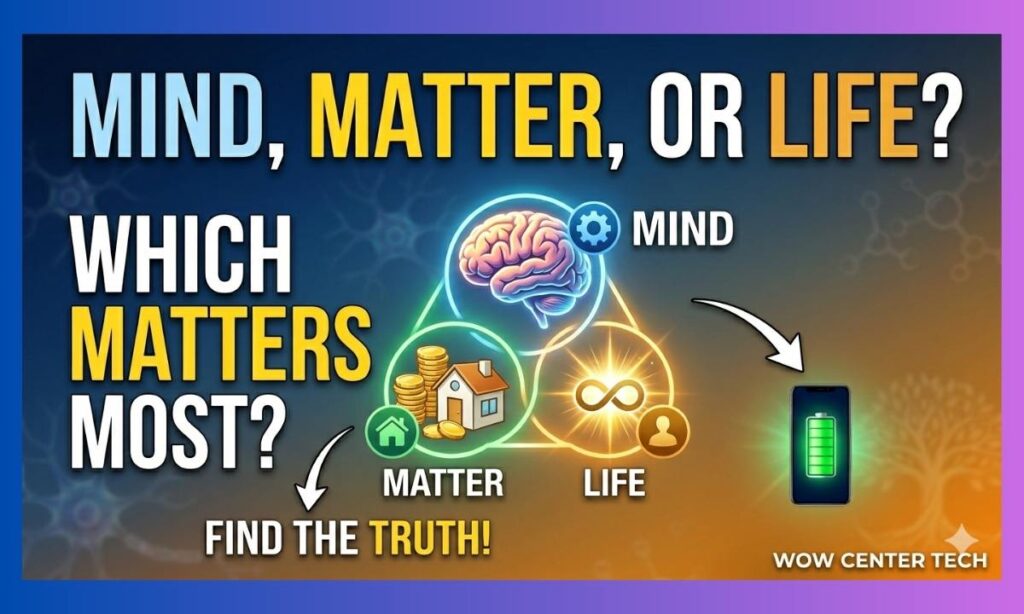
Mind, Matter, and Life: Which One Truly Defines Your Existence?
Every human being, at some point in their journey, pauses to ask a fundamental question: What actually matters most?
Is it the physical world around us? Is it the thoughts racing through our heads? Or is it the simple, quiet pulse of existence itself? Depending on who you ask, you will get very different answers. Some prioritize Matter—the tangible assets like money, homes, and food. Others champion the Mind—focusing on intelligence, psychology, and emotional well-being. Then there are those who point toward Life—the vital energy and breath that keeps us moving.
In the philosophy of Chetasyog, these three elements are not rivals competing for your attention. Instead, they exist in a delicate synergy. To understand how to live a balanced life, we must explore how our perspective changes as we grow in awareness.
The Layperson’s Perspective: The Three-Legged Stool
For most of us, life feels like balancing on a three-legged stool. If one leg is weak, the whole structure wobbles. However, we usually prioritize these legs based on immediate necessity.
1. Matter (The Foundation of Survival)
In our daily lives, matter often takes the top spot. We need food, clothing, and shelter to survive. In the modern world, money becomes the ultimate symbol of matter because it acts as the gateway to these necessities. From this viewpoint, the logic is simple: “If I don’t have the material means to survive, nothing else matters.”
2. Mind (The Driver of Success)
Once our basic survival is secured, we shift our focus to the mind. This is where education, career growth, and social status live. The mind handles our emotions, manages our stress, and builds our relationships. If matter is the fuel, the mind is the driver of the car, deciding which direction to take and how fast to go.
3. Life (The Forgotten Spark)
Ironically, the most essential element—life itself—is often the most ignored. We rarely think about our heartbeat or the rhythm of our breath until something goes wrong. For many, life is like the electricity in a house; we only notice it when the power goes out.
The typical priority list looks like this:
- First Priority: Matter (Survival)
- Second Priority: Mind (Comfort and Success)
- Third Priority: Life (Only remembered during a crisis)
The Mobile Phone Analogy
To make this clearer, imagine a smartphone:
- The Hardware (Matter): The screen, the battery casing, and the internal circuits.
- The Software (Mind): The apps, the operating system, and the processing power.
- The Electricity (Life): The actual charge that allows the phone to turn on.
Most people spend their time worrying about the phone’s appearance or which apps are running. But if the battery is dead, the most expensive hardware and the smartest apps are completely useless. Matter and mind only have value because life is present.
The Chetasyog Perspective: Reversing the Order
Chetasyog invites us to flip our perspective. It suggests that our common priority list is upside down. When we look deeper, we see a different reality:
- Life is the Essence: It is the cosmic consciousness flowing through us. It isn’t just “staying alive”; it is the source of awareness itself.
- The Mind is the Storyteller: It interprets our experiences. Ideally, the mind should be a mirror reflecting the light of life. When it becomes clouded by ego or fear, the reflection becomes distorted.
- Matter is the Garment: Our bodies, houses, and possessions are like borrowed clothes. They are useful and should be cared for, but they are not our ultimate identity.
In Chetasyog, the order of importance is restored:
- Life: The source and root.
- Mind: The tool for awareness and harmony.
- Matter: The support system for physical existence.
The Cinema Screen Analogy
Think of being in a movie theater.
- The Screen is Life.
- The Projector is the Mind.
- The Images on the screen are Matter.
Most people get lost in the movie—the drama of material life. Some admire the mechanics of the projector—the power of the intellect. But without the screen, neither the projector nor the movie can exist. Chetasyog reminds us that the screen is the only thing that remains constant, regardless of what movie is playing.
How to Live in Harmony
Understanding this hierarchy doesn’t mean you should give up your possessions or stop using your brain. Instead, it’s about alignment:
- Respect Matter: Take care of your body and your finances, but do not worship them. Treat them as tools that support your journey.
- Train the Mind: Don’t let your thoughts become a restless master. Train your mind to be a watchful servant that honors the present moment.
- Honor Life: Practice mindful breathing and silent awareness. Recognize the miracle of your own existence every single day.
Conclusion
From a distance, matter seems the most important because it is what we touch and see. But the truth revealed by Chetasyog is that Life is the root. The mind is the manager meant to serve that life, and matter is the support system that makes the experience possible.
When we let Life lead, the mind aligns, and matter supports us naturally. We stop just existing and start truly living. Everything in your world runs only because Life is “on.” Without that spark, the rest is silence. Embrace the synergy of your existence and find the wholeness that comes from putting Life first.