
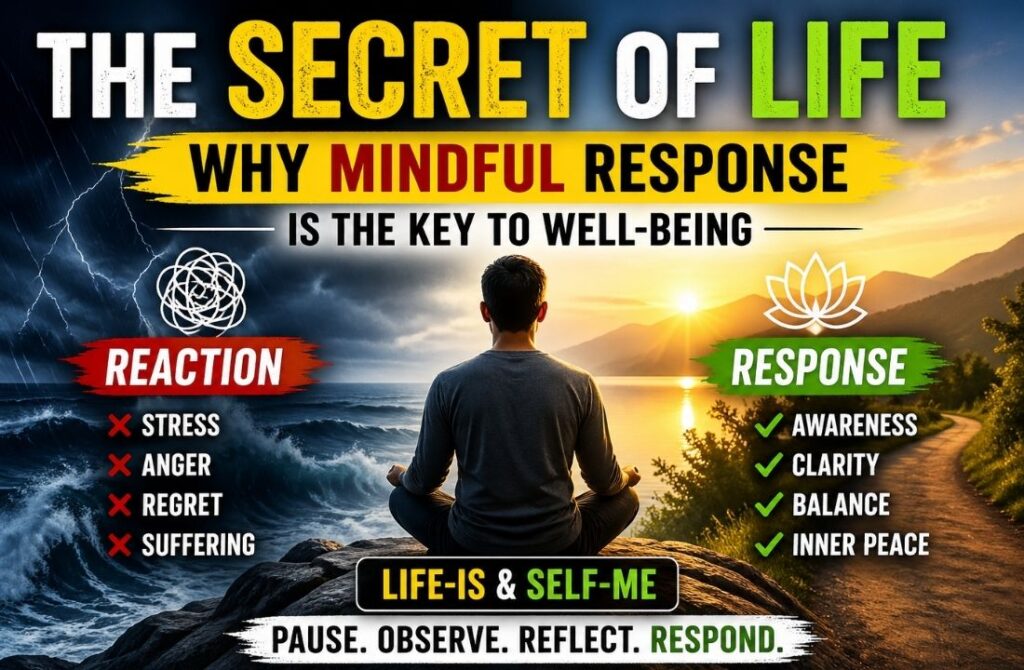
The Secret of Life: Why Mindful Response Is the Key to Well-Being
Have you ever felt trapped in a cycle where life seems to happen to you? Difficult situations, unexpected setbacks, and repeated patterns of stress can make it feel as if life is in control while you are simply reacting. Many people ask themselves why the same struggles keep returning and why they respond in the same unhealthy ways again and again.
What if the answer is simpler than it seems?
The secret to well-being may not lie in controlling everything around you, but in learning how to respond mindfully to whatever life brings. This idea is at the heart of Chetasyog, a path of awareness that teaches harmony between two core dimensions of human existence: Life-Is and Self-Me.
Understanding Life-Is and Self-Me
According to Chetasyog, every human experience involves an ongoing relationship between two forces.
Life-Is: The Flow of Existence
Life-Is refers to the greater movement of life itself. It is the natural flow of causes and consequences that shapes everything around us. Seasons change, actions create results, and events unfold according to patterns larger than any individual.
Rain falls and plants grow. Effort creates progress. Choices lead to outcomes.
Life-Is does not judge or favor anyone. It simply moves according to the laws of nature and reality.
Self-Me: The Personal Experience
Self-Me is the individual identity. It includes your thoughts, emotions, memories, beliefs, habits, body, and actions. It is the part of you that experiences life personally.
While Life-Is is the ocean, Self-Me is the boat navigating through it.
You cannot stop the waves, but you can learn how to steer.
Why Suffering Happens
Many people suffer not because life is difficult, but because they react unconsciously to difficulty.
When Self-Me becomes dominated by fear, anger, pride, or attachment, it loses connection with the wider intelligence of Life-Is. Instead of responding wisely, it reacts automatically.
This often creates unnecessary stress, conflict, and emotional pain.
For example, imagine someone cuts you off in traffic.
An automatic reaction may be anger, anxiety, or frustration. Your body becomes tense, your mind becomes agitated, and the rest of your day is affected.
A mindful response would be different.
You notice the event, understand the situation, stay calm, adjust safely, and continue forward without carrying emotional baggage.
The external situation may be the same, but the inner result is completely different.
Reaction vs Response
This is one of the most important distinctions in well-being.
Reaction
A reaction is fast, emotional, habitual, and unconscious. It usually comes from past conditioning.
Examples include:
- Getting angry when criticized
- Feeling hopeless after failure
- Becoming anxious when plans change
- Blaming others during stress
Response
A response is thoughtful, aware, balanced, and intentional. It comes from presence rather than habit.
Examples include:
- Listening calmly to criticism
- Learning from failure
- Adapting when plans change
- Taking responsibility during stress
The more you live through response instead of reaction, the more peaceful and effective your life becomes.
Why Most People Stay Stuck
Automatic reactions are deeply conditioned. They are shaped by childhood experiences, social pressure, fear, and repeated habits.
If someone grows up believing failure is shameful, they may react with anxiety every time they make a mistake.
If someone learns to seek approval constantly, they may feel empty when others disapprove.
These patterns can continue for years unless they are brought into awareness.
Chetasyog teaches that transformation begins not with self-judgment, but with observation.
Instead of asking, “What is wrong with me?” ask:
- What is happening inside me right now?
- What belief is driving this reaction?
- What is life teaching me in this moment?
These questions open the door to change.
The Benefits of Mindful Response
When you learn to respond mindfully, several positive shifts happen naturally.
Mental Clarity
You think more clearly and make better decisions.
Emotional Balance
You become less controlled by anger, fear, and anxiety.
Stronger Relationships
You communicate with patience instead of impulsiveness.
Inner Peace
You stop fighting every wave of life and begin flowing with reality.
Personal Growth
Challenges become opportunities for learning instead of sources of suffering.
This is what Chetasyog describes as whole oneself well-being, where body, mind, emotions, and actions begin working together in harmony.
Why This Matters in the Modern World
Today’s world moves quickly. Technology, constant notifications, social pressure, and artificial intelligence have increased speed and convenience, but not necessarily peace.
Many people have more tools than ever before, yet feel more disconnected than ever.
External systems can solve practical problems, but inner harmony still requires awareness.
That is why mindful response is so valuable today. It helps people remain centered in a fast-moving world.
How to Practice Mindful Response Daily
You do not need to change your entire life overnight. Begin with small steps.
1. Pause Before Reacting
When stress appears, stop for a moment and take a few deep breaths.
2. Observe Without Judgment
Notice your thoughts, emotions, and body sensations.
3. Reflect on Consequences
Ask yourself what result your reaction will create.
4. Choose Wisely
Take the action that creates peace, clarity, and progress.
5. Practice Consistently
The more often you do this, the more natural it becomes.
Final Thoughts
Life will always contain change, uncertainty, and challenge. You cannot control every event, but you can transform the way you meet those events.
Life-Is is the greater rhythm of existence.
Self-Me is your personal journey within it.
The secret of well-being lies in bringing these two into harmony through mindful response.
Instead of fighting every wave, learn to navigate wisely.
Pause, observe, reflect, and respond.
That is where peace begins.