
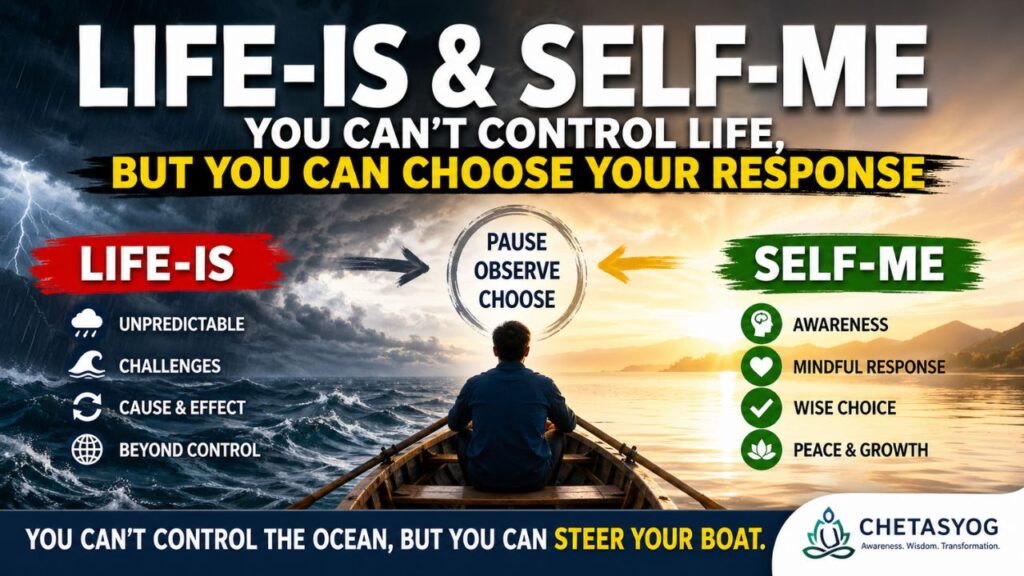
Chetasyog Explains Control, Choice, and Response Between Life-Is and Self-Me
Life can feel unpredictable. Some days everything flows smoothly, while other days challenges seem to arrive one after another. Many people wonder why some individuals stay calm during difficulties while others become trapped in stress, anger, or fear.
According to Chetasyog, the answer lies in understanding the relationship between two important dimensions of existence: Life-Is and Self-Me.
Life-Is represents the greater flow of life and universal cause and effect. Self-Me represents the individual self that experiences life and chooses how to respond.
When we understand the connection between these two, we begin to live with greater awareness, peace, and balance.
What Is Life-Is?
Life-Is can be understood as the natural flow of existence. It includes the events, circumstances, and situations that arise in daily life.
Examples of Life-Is include:
- Unexpected rain that makes you late for work
- A chance meeting with someone who lifts your mood
- A challenge at work that creates pressure
- Sudden changes in health, relationships, or finances
These events are not automatically good or bad. They are simply part of life unfolding through natural causes and consequences.
Chetasyog teaches that Life-Is does not judge. It does not reward or punish in a personal sense. It simply moves according to the laws of existence.
What Is Self-Me?
Self-Me is the individual self that thinks, feels, reacts, and chooses.
If Life-Is is the ocean, then Self-Me is the boat moving through it. The boat cannot control the ocean, but it can learn how to navigate wisely.
This is where human freedom exists.
We may not control every event that happens, but we can influence the quality of our response.
Two Ways Self-Me Responds to Life
Habitual Reaction
Many people react automatically based on old conditioning.
Common reactions include:
- Fear when things go wrong
- Anger when others disappoint us
- Desire when we want quick results
- Frustration when life feels unfair
These reactions often create repeated cycles of suffering.
For example, if someone cuts in front of you in traffic, the immediate reaction may be anger, shouting, or stress.
Mindful Response
Chetasyog teaches that Self-Me also has the ability to pause and respond consciously.
A mindful response includes:
- Taking a breath
- Observing the situation clearly
- Reflecting before acting
- Choosing calm and wise action
Using the same traffic example, instead of reacting in anger, you may simply remain calm and continue safely.
This shift changes your inner experience completely.
The Ocean and Boat Analogy
Imagine Life-Is as a vast ocean and Self-Me as a small boat.
The ocean brings calm waters, storms, waves, and tides. The boat cannot stop these changes.
However, the boat can learn to adjust its direction and use skillful navigation.
If the boat reacts blindly to every wave, it may capsize.
If the boat responds wisely, it can continue moving forward with balance.
This is the heart of Chetasyog.
True power does not come from controlling life. It comes from learning how to respond to life.
Why This Understanding Matters
Many people believe freedom means controlling everything around them.
They want no problems, no discomfort, and constant success.
But real freedom is different.
Real freedom is the ability to remain aware and choose your response, even when circumstances are difficult.
Consider two people who lose their jobs.
One person reacts with fear, blame, and despair.
The other person reflects calmly, learns from the experience, and begins searching for a new path.
Both faced the same event, but their inner responses created different futures.
How to Practice Chetasyog Daily
You do not need complicated rituals to apply this wisdom. Start with these three simple steps.
1. Pause
When stress appears, stop for a moment before reacting.
Pause during conflict, disappointment, criticism, or uncertainty.
2. Observe the Situation Clearly
Ask yourself:
- What is happening right now?
- What consequence is naturally arising?
- Am I seeing this clearly or emotionally?
This creates awareness.
3. Choose Wisely
Instead of reacting through fear or anger, choose a response that supports peace and growth.
You can:
- Speak calmly
- Listen carefully
- Take responsible action
- Learn from the moment
- Let go when needed
A Simple Example at Work
If someone criticizes your performance, the old pattern may be defensiveness or resentment.
A mindful approach would be:
- Pause
- Listen carefully
- Evaluate what is useful
- Improve where needed
- Stay emotionally balanced
This turns conflict into growth.
Your First Practical Step
The next time stress rises, ask yourself one question:
Am I reacting from conditioning, or responding with awareness?
This small question can transform many moments in life.
With practice, wise response becomes natural.
The Core Message of Chetasyog
Chetasyog teaches a simple truth:
Life-Is moves through causes and consequences.
Self-Me has the freedom to respond consciously.
When we stop fighting life and start understanding it, we feel lighter, clearer, and more connected.
Life becomes less about control and more about conscious participation.
Final Thought
You do not need to control every wave in the ocean of life.
You only need to learn how to steer your boat wisely.
Pause. Observe. Reflect. Choose well.
That is the path of conscious living through Chetasyog.