
How to Stop Overthinking and Relax Your Mind
Overthinking has become one of the most common struggles in modern life. Many people keep replaying conversations, worrying about the future, analyzing situations repeatedly, and imagining problems that may never happen. This constant mental activity slowly drains emotional energy and creates inner restlessness.
If you often ask yourself how to stop overthinking and relax your mind, the answer may not lie in controlling every thought. The real solution begins by understanding what is happening within the mind and emotions through awareness.
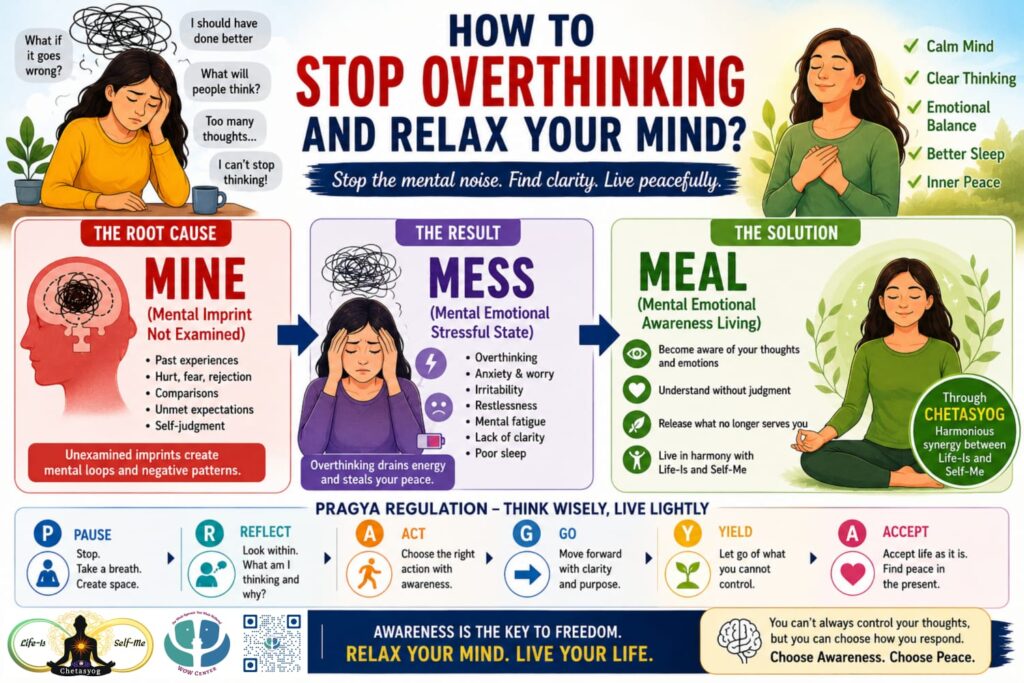
The Wisdom of Wellbeing approach explains this through MINE, MESS, MEAL, PRAGYA, and Chetasyog reflection.
Why Overthinking Happens
Most overthinking does not begin in the present moment. It comes from unresolved mental impressions stored within us from past experiences, fears, judgments, failures, expectations, insecurities, and emotional hurts.
These hidden mental residues are called MINE which means Mental Imprint Not Examined.
For example, a person who faced rejection in the past may continuously overthink relationships. Someone who experienced criticism may overanalyze every conversation. A person carrying fear of failure may keep worrying about future outcomes.
These unnoticed mental imprints silently influence thoughts and emotional reactions.
Over time, these accumulated patterns create inner stress, emotional confusion, anxiety, restlessness, and mental exhaustion. This state is called MESS which means Mental Emotional Stressful State.
Many people try to stop overthinking through distraction, entertainment, social media scrolling, or temporary motivation. But the mind becomes calm only when deeper awareness develops.
How Overthinking Affects the Mind and Body
Constant overthinking keeps the nervous system in continuous alert mode. Even while resting physically, the mind remains active internally.
This often leads to poor sleep, emotional fatigue, irritation, low concentration, anxiety, mood swings, and difficulty enjoying simple moments of life.
The mind becomes like muddy water constantly stirred by movement. When there is no pause or awareness, clarity disappears.
This is why relaxing the mind is not only about positive thinking. It is about understanding the roots of inner disturbance.
MEAL Awareness Through Chetasyog
The Wisdom of Wellbeing approach offers MEAL which means Mental Emotional Awareness Living.
MEAL is the practice of becoming aware of thoughts, emotions, reactions, and inner patterns without escaping from them.
This awareness is part of Chetasyog, the harmonious synergy between Life-Is and Self-Me.
Understanding Life-Is and Self-Me
Life-Is represents the deeper flow of life consciousness, while Self-Me represents personal identity shaped through memories, emotions, body, personality, and social experiences.
When Self-Me becomes trapped in fears, comparisons, and mental noise, overthinking increases. But when awareness reconnects Self-Me with Life-Is, the mind gradually begins to relax naturally.
Instead of fighting thoughts, a person starts observing them with clarity.
PRAGYA Regulation to Relax the Mind
PRAGYA offers a practical way to stop overthinking and respond wisely.
P – Pause before reacting to every thought
R – Reflect on whether the thought is real or fear based
A – Act only on what truly needs attention
G – Go forward without carrying unnecessary mental burden
Y – Yield where control is not possible
A – Accept uncertainty and present reality peacefully
This process slowly reduces mental clutter and emotional pressure.
Final Reflection
If you are searching for how to stop overthinking and relax your mind, remember that the mind does not become peaceful through force. Peace develops through awareness.
Unexamined MINE creates MESS, but mindful MEAL awareness and PRAGYA regulation help restore balance within.
Through the Chetasyog reflection of harmony between Life-Is and Self-Me, overthinking slowly transforms into clarity, emotional steadiness, and inner wellbeing.
A relaxed mind is not an empty mind. It is a mind living with awareness.