
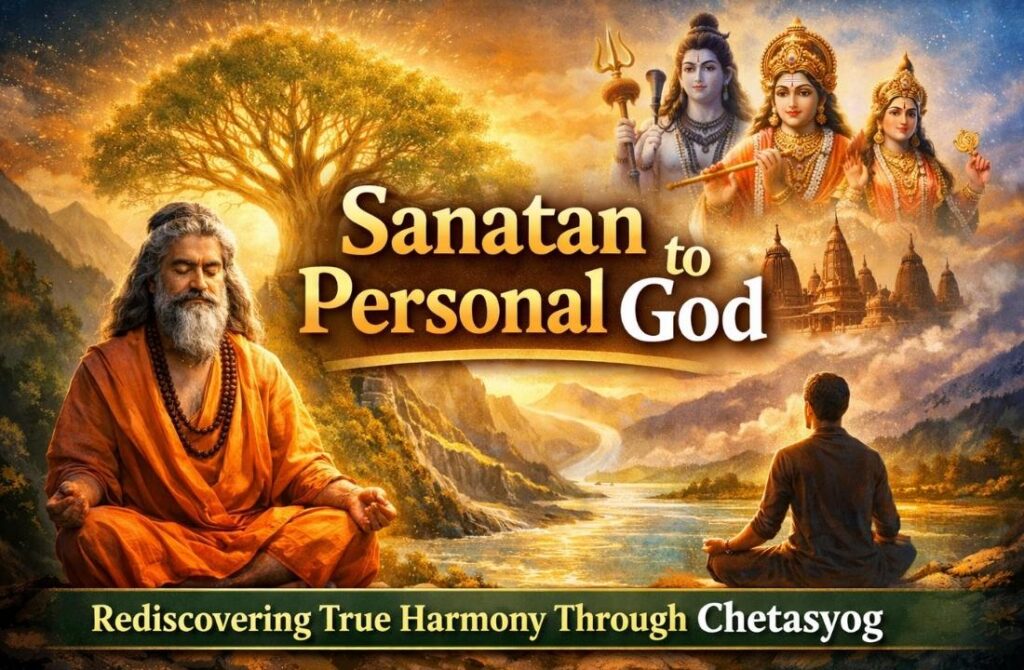
Sanatan Dharma to Personal God: Rediscovering True Harmony Through Chetasyog
Introduction
When most people hear the word Hinduism, they think of temples, rituals, idols, festivals, and many gods and goddesses. While these elements are part of its expression today, the roots go much deeper. At its core lies Sanatan Dharma, an ancient and timeless wisdom that focuses on understanding life, the self, and the connection between the two.
This blog explores the journey from the original essence of Sanatan Dharma to the rise of personal gods and rituals, and how the path of Chetasyog can help rediscover true inner harmony.
What Is Sanatan Dharma
Sanatan Dharma is not a religion in the conventional sense. It is an eternal system of wisdom that explains the nature of life and existence. It teaches that there is a universal intelligence that governs everything. This intelligence can be understood as the essence of life itself.
According to this understanding, the individual self is not separate from the whole. Each person is part of a larger cosmic system. Just as a drop of water is not separate from the ocean, human existence is deeply connected to the flow of life.
The purpose of Sanatan Dharma is not to create belief systems, but to guide individuals toward self understanding, awareness, and selfless living.
The Shift Toward Personal Gods and Rituals
Over time, the abstract and formless nature of this wisdom became difficult for many people to grasp. The human mind often prefers something tangible and relatable. As a result, spiritual concepts began to take the form of personal gods and stories.
Deities such as Shiva, Vishnu, Krishna, Durga, and Lakshmi came to represent different aspects of life such as creation, preservation, transformation, strength, and prosperity. This made spirituality more accessible to the common person.
Rituals, prayers, and temple practices developed as structured ways to stay connected to the divine. These practices helped people build discipline and faith.
However, with time, many of these practices became mechanical. Instead of understanding their deeper purpose, people began to follow them out of habit or expectation. The focus gradually shifted from self realization to seeking material benefits or external blessings.
Why the Original Essence Was Lost
This transformation is not unusual. When complex wisdom is passed down through generations, it is often simplified. While simplification makes it easier to follow, it can also dilute the original meaning.
Sanatan Dharma was meant to help individuals understand their connection with life itself. But over time, this deeper inquiry was replaced by routine practices and surface level beliefs.
It is similar to reducing a powerful and meaningful story into short points. The details may remain, but the essence is lost.
Chetasyog and the Path of Awareness
Chetasyog offers a way to reconnect with the original intent of Sanatan Dharma. It is not about rejecting rituals or beliefs, but about going beyond mechanical actions and developing true awareness.
Chetasyog focuses on the relationship between life as a whole and the individual self. It encourages a direct experience of this connection rather than relying only on external practices.
In simple terms, life can be seen as a vast, intelligent system, and each individual is an expression of that system. The goal is to recognize this unity and live in harmony with it.
Understanding Through Simple Analogies
A helpful way to understand this is through nature.
Consider a tree and its leaves. Each leaf appears separate, yet it is completely connected to the tree. The life of the leaf depends on the tree, and the tree expresses itself through its leaves.
Similarly, individuals may appear separate, but they are deeply connected to the larger flow of life. Recognizing this connection is the beginning of true awareness.
Relevance in the Modern World
In today’s fast paced world, especially in the age of technology and artificial intelligence, people are increasingly focused on personal success, achievements, and material growth.
While these pursuits are important, they often lead to stress, anxiety, and a sense of disconnection. Many people feel restless despite achieving their goals because they are disconnected from their deeper nature.
This is where the principles of Chetasyog become valuable. By shifting attention inward and understanding the connection with life, individuals can develop clarity, emotional balance, and a sense of purpose.
Simple Ways to Practice Chetasyog
Chetasyog does not require complex rituals. It can be practiced through simple and consistent awareness.
Mindful breathing helps bring attention to the present moment and connects the individual with the flow of life.
Daily reflection allows observation of thoughts and emotions without judgment, creating deeper self awareness.
Gratitude toward life itself builds a sense of connection and appreciation beyond material desires.
Observing nature helps in recognizing the harmony and intelligence present in all forms of life.
The Real Transformation
The true shift happens when life is no longer seen as a series of separate experiences, but as a unified flow. Instead of asking which practice to follow or which deity to worship, the focus moves toward living with awareness and harmony.
This does not mean abandoning traditions. It means understanding their purpose and going beyond mechanical repetition.
The essence of Sanatan Dharma lies in realizing that life is not separate from the self. Chetasyog helps in experiencing this truth directly.
Conclusion
Sanatan Dharma represents a deep and infinite understanding of life. Over time, its expression evolved into rituals and personal forms of devotion, which made it more accessible but also led to a loss of its core essence.
Chetasyog offers a way to reconnect with that essence by focusing on awareness, connection, and conscious living.
The journey is not about rejecting what exists, but about rediscovering the truth behind it. When this understanding becomes a lived experience, life naturally moves toward balance, clarity, and harmony.