
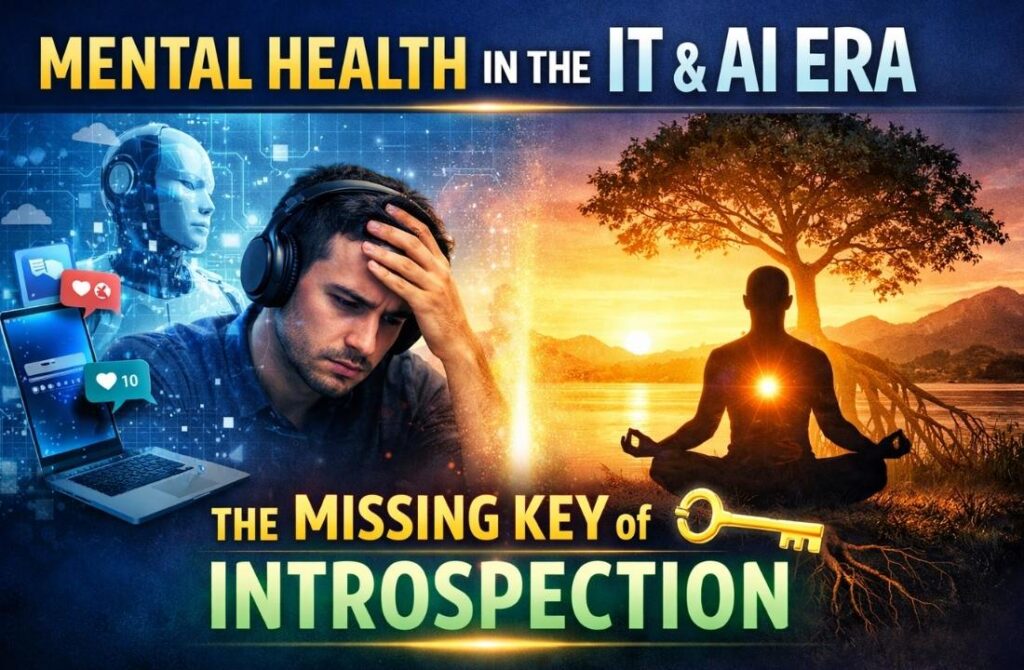
Mental Health in the IT and AI Era: The Missing Key of Introspection
In today’s fast paced world, we are living through a powerful technological transformation. Smartphones, artificial intelligence, and social media have made life more connected and efficient than ever before. Yet, despite these advancements, mental health challenges such as anxiety, depression, mood instability, and burnout are increasing at an alarming rate.
This raises an important question. If technology is making life easier, why are people feeling more stressed and disconnected?
The answer does not lie in technology itself, but in how we relate to our own inner world. Most people today are deeply engaged with the external environment while neglecting the inner connection that shapes true well being.
The Problem: Living Only Through Extrospection
Extrospection refers to focusing entirely on the outside world. It includes observing people, comparing achievements, chasing success, and seeking validation from society.
In modern life, many individuals define themselves through their appearance, career status, financial success, and social media presence. Common thoughts in this mode often include questioning personal worth based on comparison with others, worrying about recognition, and constantly seeking approval.
While this outward focus may seem necessary for growth, excessive extrospection creates imbalance. It leads to constant comparison, fear of missing out, stress from competition, and a gradual disconnection from one’s deeper sense of purpose.
When attention is always directed outward, individuals may appear successful on the surface but still feel empty within.
The Shift: Understanding Introspection
Introspection is the practice of turning attention inward. It is not just thinking about oneself, but calmly observing thoughts, emotions, and inner experiences without judgment.
Through introspection, individuals begin to explore deeper questions such as
Who am I beyond my roles and achievements
What is the deeper intelligence guiding my life
What is the source of my thoughts and emotions
This inward awareness helps people reconnect with a more stable and meaningful sense of self.
The Role of Chetasyog in Inner Awareness
Chetasyog introduces a deeper understanding of human existence by highlighting the relationship between two dimensions
Self Me refers to the individual identity, including personality, body, and personal experiences
Life Is refers to the universal life force or cosmic intelligence that flows through every living being
According to this perspective, mental well being emerges when there is harmony between these two aspects. When individuals focus only on Self Me, they become vulnerable to stress and instability. But when they connect with Life Is through awareness, they experience balance and clarity.
A Simple Analogy
Consider a tree. The visible parts such as leaves, branches, and fruits represent the external identity. The roots, which remain unseen, provide nourishment and stability.
If the roots are weak, the tree cannot sustain itself, no matter how healthy it appears on the outside. Similarly, without inner connection, external success alone cannot support long term well being.
Why This Matters in the IT and AI Era
The modern digital environment encourages constant engagement, productivity, and performance. People are often treated like systems that must deliver continuous output.
This creates several challenges
Rising anxiety due to constant comparison and pressure
Mental fatigue from digital overload
Loss of purpose beyond professional success
Emotional disconnection despite social connectivity
As artificial intelligence continues to evolve, human beings must strengthen what makes them truly human, which is awareness, presence, and inner connection.
Chetasyog offers a practical approach to restore this balance by encouraging individuals to align their inner awareness with their outer actions.
Simple Practices for Daily Life
Pause and Observe
Take small breaks during the day to notice your thoughts and emotions. Instead of reacting instantly, develop the habit of observing what is happening within.
Connect with Nature
Spending time in natural surroundings helps calm the mind and reconnect with a deeper rhythm of life.
Ask Meaningful Questions
Reflect on questions that go beyond daily tasks. This helps shift attention from routine thinking to deeper understanding.
Write Regularly
Journaling thoughts and feelings can bring clarity and strengthen the connection between inner awareness and daily experience.
The Outcome: True Mental Well Being
When individuals develop harmony between Self Me and Life Is, they begin to experience
Reduced stress and emotional stability
Clarity of purpose and direction
Greater resilience in challenging situations
A natural sense of peace and fulfillment
This balance allows people to function effectively in the external world without losing connection with their inner self.
A Real Life Reflection
Consider a young professional working in the technology sector. Despite achieving career growth and financial stability, he feels constant pressure and dissatisfaction.
When he begins practicing introspection through simple awareness and reflection, he gradually notices a shift. His anxiety reduces, his decisions become clearer, and he starts experiencing a sense of purpose beyond external success.
This transformation does not come from changing the external world, but from changing the relationship with the inner self.
Conclusion
In the age of rapid technological advancement, mental health cannot be sustained by external achievements alone. The missing element is introspection, the ability to turn inward and understand the deeper nature of one’s existence.
Chetasyog offers a simple yet powerful path to reconnect with this inner dimension. By balancing the individual identity with the universal flow of life, individuals can move towards a more stable, meaningful, and harmonious way of living.
The future will continue to evolve with technology, but true well being will always depend on how deeply we understand ourselves.