
Here’s a clean, human-written, SEO-friendly rewrite of your blog without symbols, while keeping it natural, engaging, and easy to read:
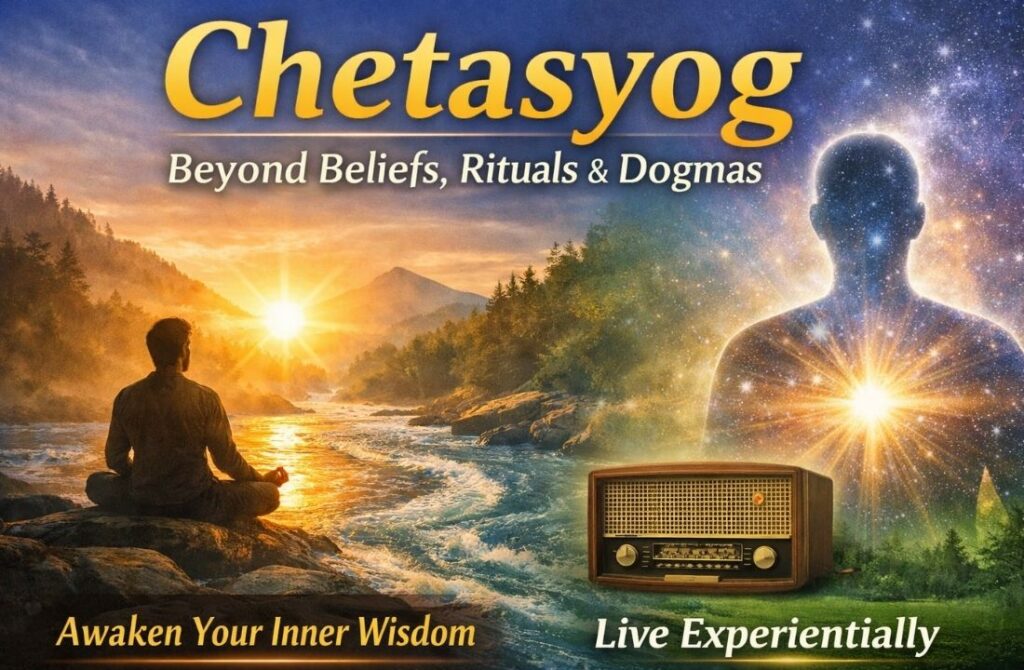
Chetasyog: A Path of Experiential Living Beyond Beliefs, Rituals, and Dogmas
Introduction
Have you ever noticed how much of your life is shaped by beliefs, rituals, and social conditioning that you never truly questioned?
From childhood, we are taught what is right and wrong, what success should look like, and even how happiness or peace should feel. While some of these teachings can be helpful, many of them quietly limit us. They can create inner conflict, repeated patterns, and a sense of being stuck.
Now imagine life as a flowing river. The river represents life itself—vast, dynamic, and guided by its own intelligence. You are in a boat, which represents your self—your body, mind, and personality navigating daily experiences.
When the boat moves with the river, the journey feels smooth and meaningful. When it resists the current or gets caught in patterns, the journey becomes exhausting.
Chetasyog is about restoring harmony between these two dimensions—life and self—so that living becomes natural, balanced, and fulfilling.
Understanding Being-Life and Being-Self
To understand Chetasyog, it helps to see life from two complementary perspectives.
Being-life refers to the universal intelligence that exists beyond form. It is the underlying presence that supports everything. You cannot see it directly, but it is always there, like the invisible force that powers existence.
Being-self refers to your individual expression—your thoughts, emotions, body, identity, and personality. This is how life expresses itself through you.
When these two are in alignment, there is clarity, ease, and a sense of wholeness. When they are disconnected, confusion and struggle arise.
Chetasyog focuses on bringing these two into natural harmony.
Why Chetasyog Is Not Based on Beliefs or Rituals
Many approaches to well-being rely on belief systems or structured practices. While these can offer guidance, they can also become restrictive over time.
Beliefs tell you how you should think.
Rituals tell you what you should do.
Dogmas discourage questioning.
Life, however, is not fixed. It is constantly changing. When you try to fit it into rigid ideas, you create resistance within yourself.
Chetasyog takes a different approach. Instead of asking you to follow predefined rules, it invites you to observe, explore, and understand your own experience directly.
It is not about following a map. It is about walking the path consciously.
The PRAGYA Method: Watchfulness Without Mental Filters
At the core of Chetasyog is the PRAGYA method, which is based on simple watchfulness.
Most of us do not see reality as it is. We see it through layers of past experiences, beliefs, and unconscious habits. These layers act like a filter that distorts perception.
PRAGYA is the practice of observing your thoughts, emotions, and reactions without judgment or interpretation. It is about seeing clearly, without the influence of fixed mental patterns.
As this watchfulness deepens, a natural transformation begins.
Regret turns into learning.
Guilt transforms into understanding.
Fear begins to dissolve into clarity.
Pain reveals insight.
This transformation does not come from belief. It comes from direct experience.
The Radio and the Signal: A Simple Analogy
Think of your self as a radio and life as a signal that is always present.
When the radio is tuned properly, the sound is clear and harmonious. When it is not, there is noise and distortion.
Most of the time, our inner state is filled with this noise—constant thinking, judgment, and emotional reactions.
Through watchfulness, you begin to tune yourself. Gradually, clarity replaces confusion, and you become more aligned with the natural flow of life.
Living Experimentally Instead of Habitually
A key aspect of Chetasyog is living experimentally rather than mechanically.
Instead of reacting automatically, you begin to observe your inner state.
When anger arises, you watch it without immediately acting on it. You notice how it builds, changes, and eventually fades.
When joy arises, you observe that as well. You see how it feels and how it passes.
This simple act of observation creates a shift. You begin to realize that you are not your thoughts or emotions. You are the awareness in which they appear.
This understanding cannot be borrowed from others. It must be experienced directly.
Whole Oneself Well-being
Whole Oneself Well-being is the natural outcome of living in harmony with life and self.
It is not about achieving a perfect state or eliminating all challenges. Instead, it is about being fully present, aware, and connected in every moment.
When you are aligned with life:
Your actions become more natural and less forced.
Your mind becomes clearer and less reactive.
Your emotions become more balanced.
Your overall experience of life becomes more meaningful.
Chetasyog is not something you follow. It is something you live.
It is a continuous journey of awareness, where each moment becomes an opportunity to understand yourself and life more deeply.
Conclusion
Chetasyog offers a simple yet profound shift—from living through borrowed beliefs and unconscious patterns to living through direct experience and awareness.
It does not ask you to believe anything. It invites you to observe, explore, and discover.