
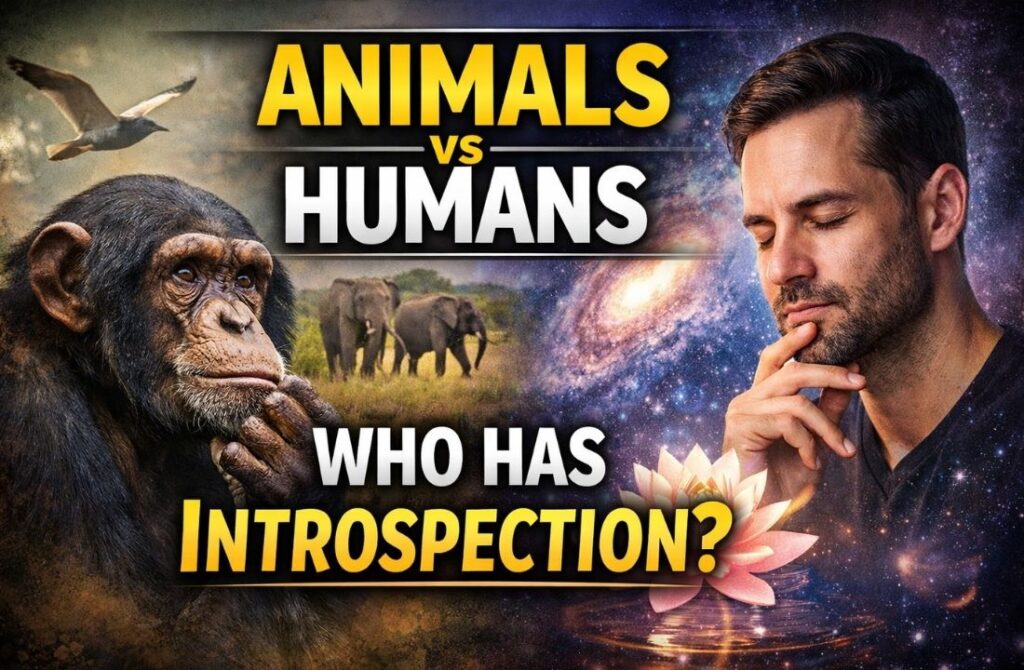
Here is a clean, human-written, SEO-friendly rewrite of your blog with a natural tone and no symbols:
Do All Living Beings Have Introspection or Only Humans
Life expresses itself through every living being, from the smallest plant to the most complex human. Yet, the way life is experienced differs deeply across species. One of the most profound questions we can ask is whether all living beings have the ability to look within, or whether introspection is a uniquely human capacity.
The Two Fundamental Powers of Life
Every living being operates through two essential powers.
The first is extrospection, which is the ability to look outward. It allows beings to respond to their environment, adapt, survive, and connect with the world around them.
The second is introspection, which is the ability to look inward. It involves self-reflection, questioning one’s own existence, and seeking meaning beyond immediate experiences.
In the language of Chetasyog, extrospection relates to the Being-Self, the aspect of us that engages with the physical, social, and personal world. Introspection, on the other hand, is the path of synergy where the individual self consciously connects with the deeper flow of life.
Extrospection Exists in All Living Beings
Every form of life demonstrates remarkable outward intelligence.
Plants turn toward sunlight and adjust to their surroundings. Birds migrate across vast distances guided by natural rhythms. Elephants remember paths and show emotional bonds within their groups. Bees communicate directions and locate food with precision.
These are all expressions of life responding intelligently to the external world. This outward responsiveness is universal. It is life flowing naturally through all beings without the need for conscious questioning.
The Unique Capacity of Humans
Humans differ in one crucial way. We do not only respond to life. We can reflect on our own responses.
We can pause and ask questions such as who we are, why we feel certain emotions, and what the purpose of our life might be. This ability to observe our own thoughts and experiences is what defines introspection.
While some animals show signs of memory, planning, and even emotional awareness, the depth of self-reflection seen in humans is far more developed. Humans possess the ability to examine their own mind, which gives rise to deeper awareness but also inner conflict.
Insights from Knowledge Traditions
Modern science explains that humans have a highly developed prefrontal cortex, enabling advanced thinking, self-awareness, and reflection. Some higher animals may show early signs of this ability, but not with the same depth.
Western philosophy has long emphasized introspection as a defining human trait. The idea of knowing oneself has been central to philosophical inquiry for centuries.
Eastern traditions such as yoga, Vedanta, and Buddhism suggest that all beings exist within a universal consciousness. However, only humans have the mental and intellectual capacity to consciously realize this connection.
From the perspective of Chetasyog, all beings are already in harmony with life at an unconscious level. Humans, however, experience a sense of separation. This separation creates both the challenge and the opportunity for conscious awareness.
The River and the Ocean Analogy
A helpful way to understand this is through the image of rivers flowing toward the ocean.
Plants and animals flow naturally, following life’s rhythm without questioning it. They remain in harmony without awareness of that harmony.
Humans, however, can pause, resist, or question their own flow. This ability can lead to confusion and struggle when awareness is absent. But when awareness is present, it allows a conscious return to harmony with life.
The Burden and the Gift of Being Human
The human ability to introspect is both a burden and a gift.
It becomes a burden when it creates feelings of separation, anxiety, and meaninglessness. Humans can feel lost because they question their place in existence.
At the same time, it is a gift because it offers the possibility of conscious awakening. Humans can move beyond confusion and rediscover a deeper sense of wholeness.
Animals do not struggle with questions about identity or purpose. Plants do not experience inner emptiness. Humans do, because they carry the potential to become aware of themselves.
A Simple Example from Daily Life
Consider a person who constantly checks social media for validation. Their emotional state depends on external reactions. This is life driven purely by extrospection.
Now imagine the same person pausing to reflect on why they seek validation. They begin to see that their sense of happiness is not dependent on external approval. This shift marks the beginning of introspection.
Through this inward awareness, life becomes more balanced. There is less dependence on the outside and a deeper connection within.
Why Humans Need Chetasyog
Plants and animals are already aligned with life in an unconscious way. Humans, because of their self-awareness, experience a gap between their individual identity and the larger flow of life.
This gap creates suffering, but it also opens the door to transformation.
Chetasyog offers a path to bridge this gap. It is not about becoming something new, but about rediscovering what already exists. It is the process of bringing the individual self and the deeper life force into conscious harmony.
Final Reflection
All living beings possess extrospection, the ability to respond to life externally. This is a universal expression of life.
Only humans possess a highly developed form of introspection, the ability to turn inward, reflect, and consciously understand their existence.
This dual capacity defines the human experience. When introspection is ignored, life becomes driven by external influences, leading to restlessness and confusion. When introspection is embraced, it leads to clarity, balance, and a sense of wholeness.
The journey of being human lies in learning to unite the outer and inner dimensions of life. Through this union, one can experience a deeper harmony that has always been present but not always recognized.