
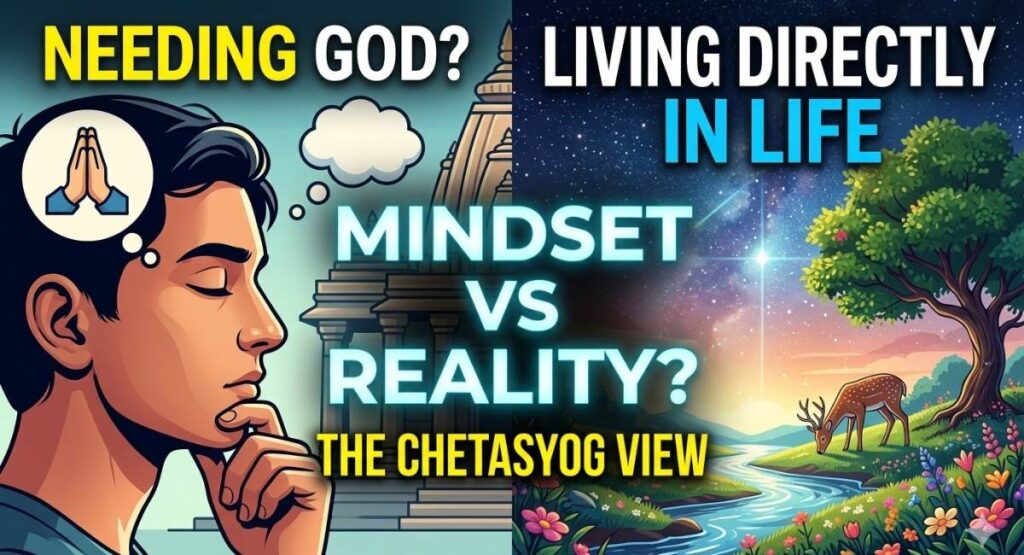
God, Life, and Chetasyog: Balancing Mindset and Reality for True Well-being
Since the dawn of time, humans have been on a relentless quest to decode the mysteries of existence. We find ourselves asking the big questions: Why am I here? Who created this universe? What happens when the lights go out? In our search for certainty, the concept of “God” emerged as a central pillar. We built temples, scripted rituals, and offered prayers, all centered around this powerful idea.
However, we rarely stop to ask a fundamental question: Why do only humans feel the need for God?
Birds, trees, rivers, and stars don’t pray. They don’t perform rituals or seek divine blessings. They simply exist. This leads us to a profound crossroads: Is God a reality existing outside of us, or a mindset crafted within us? More importantly, how does this affect our individual existence (Being-self) and our connection to cosmic consciousness (Being-life)?
God as a Reflection of the Human Mind
For many, God resides within the “Being-self”—the realm of our bodies, emotions, and social identities. In this space, God often takes whatever shape our mindset requires at the moment:
- A Mindset of Fear: God becomes the Protector, the shield against pain and disaster.
- A Mindset of Desire: God becomes the Giver, the source of wealth, success, and health.
- A Mindset of Guilt: God becomes the Judge, the one who offers or withholds forgiveness.
- A Mindset of Loneliness: God becomes the Companion, ensuring we never feel truly alone.
Essentially, God is often a projection of what we feel is missing in ourselves. It is a way to fill the gaps created by our own insecurities.
The Screen vs. The Movie: Life Beyond God
If we look at “Being-life”—the broader cosmic consciousness—we see a different story. Life is infinite and self-sustaining. Nature doesn’t need to imagine a creator because it lives directly in the flow of existence.
Consider this analogy: Think of a cinema screen and the movie playing on it.
- The Movie represents our “Being-self”—our drama, roles, and problems.
- The Screen represents “Being-life”—the silent, constant background of consciousness.
Humans often get so caught up in the plot of the movie that we forget the screen. For many, God is a comforting storyline within the movie. But the screen itself—Life—doesn’t need the story to exist.
Why Humans Crave God While Nature Does Not
Unlike other living beings, humans possess a complex thinking mind. While this allows for incredible creativity, it also generates unique forms of suffering:
- Awareness of Mortality: We are the only species that knows it will die. This creates a deep-seated longing for something eternal.
- Psychological Insecurity: We don’t just live in the moment; we live in memories of the past and anxieties about the future. God provides a calm harbor in that mental storm.
- The Search for Purpose: We have an inherent need for life to mean something. God provides a framework that makes our existence feel intentional rather than random.
Animals don’t face these existential crises. A dog doesn’t ask “Why me?” or worry about its legacy. Animals live in direct synergy with Life, following instinct and nature without the interference of an ego-driven identity.
The Chetasyog Perspective: From Faith to Awareness
Chetasyog offers a refreshing lens on this dynamic. It suggests that humans invented the concept of God because our “Self” often feels disconnected from “Life.” God acts as a bridge of faith to close that gap.
Traditional religions often emphasize an external God because it is easier to teach hope and obedience than it is to cultivate deep inner awareness. Unfortunately, this often leads to division—my God versus your God—creating conflict in the name of the divine.
Chetasyog invites a shift in perspective:
- From Faith to Experience: Instead of blindly believing in something external, we move toward experiencing life directly.
- From Division to Synergy: While religious labels can divide us, the realization of shared “Being-life” unites all living things.
- From Escaping to Living: God is often used as an escape from fear. Chetasyog encourages us to find harmony in the present moment, exactly as it is.
Finding the Divine Within
In the practice of Chetasyog, the search for God eventually dissolves. When the “Self” realizes its natural union with “Life,” the divine is no longer something to worship from afar. It becomes something to live out every day through harmony, presence, and wholeness.
To the layperson, God may be a necessary mental support to handle the stresses of life. But for the Chetasyogi, the divine is the total synergy of Being-life and Being-self. It is the realization that the root of the tree is more important than the individual branches.
By shifting our focus from “God as a mindset” to “Life as a reality,” we can stop fighting over the stories in the movie and start appreciating the vast, beautiful screen that holds it all together. That is the essence of true well-being: living in natural unity with the cosmic flow.