
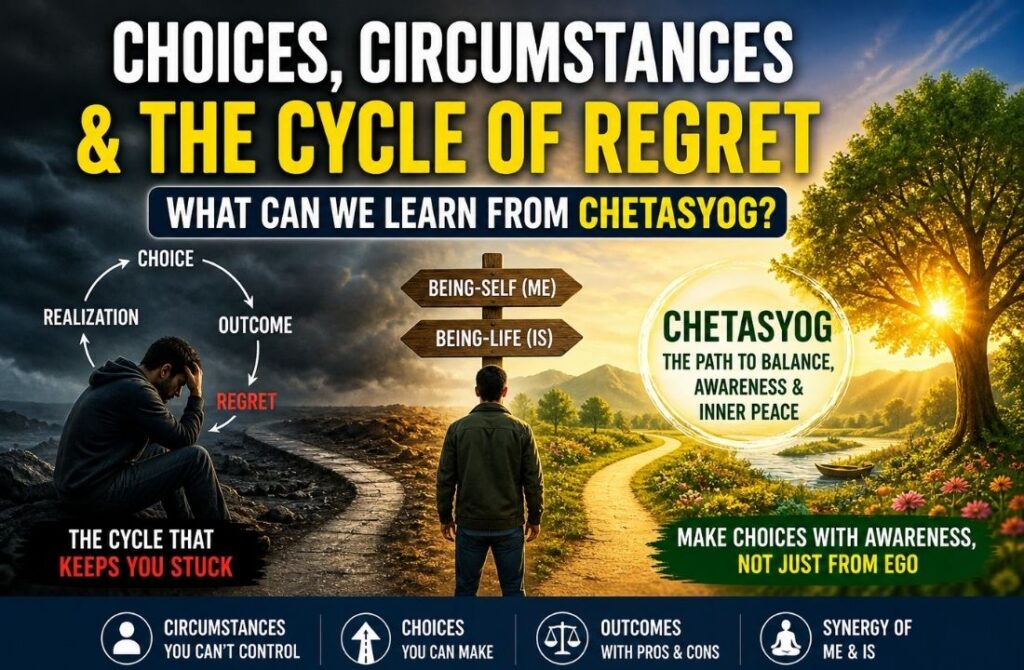
Choices, Circumstances and the Cycle of Regret: What Can We Learn from Chetasyog?
Introduction
Every person lives within circumstances that are not entirely in their control. Yet, most of us carry the feeling that we are in charge of everything. In reality, life does not give us control over situations. It offers us choices. And every choice carries its own set of advantages and disadvantages.
Because of this, people often find themselves stuck in a repeating cycle of choices, outcomes, and emotional reactions like satisfaction or regret. However, there is a deeper and more balanced way to live. This is where the path of Chetasyog becomes meaningful, helping create harmony between the individual self and the greater flow of life.
Understanding Circumstances and Choices
Life can be compared to a stage play.
The stage represents circumstances, which are already set and not chosen by us. What we can choose is how we act on that stage. Our actions are our choices.
Every choice leads to outcomes that contain both positive and negative aspects. For example, choosing a new job may bring a higher income but could reduce time spent with family. This dual nature exists in almost every decision we make.
How the Self Makes Decisions
Most people make choices based only on their personal mindset. These decisions are often influenced by ego, fear, desire, habits, or comparison with others.
As a result, life becomes a continuous loop:
Choice leads to outcome, outcome leads to realization, and realization leads to another choice.
Since these choices come from a limited perspective, the outcomes also bring mixed experiences.
The Emotional Cycle of Satisfaction and Regret
After outcomes unfold, people usually experience either satisfaction or regret.
When things go as expected, they feel satisfied. When they do not, regret takes over.
What is important to understand is that both satisfaction and regret get stored in the subconscious mind. Over time, they begin to influence future decisions without us even realizing it.
For instance, regret from a past relationship may create fear of opening up again. Similarly, pride from success may lead to arrogance. These emotional imprints keep repeating patterns in life and keep individuals tied to outcomes.
The Garden of Life Analogy
Imagine life as a garden.
Circumstances are like changing seasons. They cannot be controlled. Choices are like the seeds we plant.
Every seed grows into something that carries both benefit and challenge. If we plant only for quick rewards, we may also experience more difficulties. But when we act with patience and awareness, we begin to experience both growth and stability.
The River and the Boat Analogy
Life can also be seen as a flowing river.
You are sitting in a boat, which represents your sense of self. The current of the river represents circumstances that are beyond your control. Your choices determine how you steer the boat.
Sometimes the current takes you to calm and beautiful places. At other times, it leads to challenges. But the river never stops flowing, and you always have the ability to adjust your direction.
The Chetasyog Perspective: Moving Beyond Regret and Satisfaction
Chetasyog introduces a deeper understanding of life by bringing together two dimensions:
Being-Self, which is the individual identity shaped by body, thoughts, and experiences.
Being-Life, which is the larger flow of existence and universal consciousness.
Most people operate only from the individual self. However, Chetasyog encourages awareness of the connection between the self and the flow of life.
When choices are made with this awareness, they are no longer driven only by fear, desire, or comparison. Instead, they align with a broader perspective.
In this state, outcomes are no longer seen as rewards or punishments. They are understood as part of life’s learning process. Satisfaction does not inflate the ego, and regret does not weigh down the heart. A sense of balance begins to develop, and inner peace becomes less dependent on external results.
Practical Lessons for Everyday Life
First, understand that circumstances are signals from life. While you cannot control them, you can choose how to respond.
Second, accept that every choice has two sides. Expecting perfect outcomes only leads to disappointment.
Third, recognize that regret and pride are temporary emotional states. They do not define who you truly are.
Fourth, practice awareness. Before making a decision, reflect on whether it is coming only from personal desire or if it aligns with a deeper sense of life’s flow.
Finally, remember that true peace comes not from controlling life, but from living in harmony with it.
Closing Reflection
Every choice you make is like planting a seed. It will grow into results that include both benefits and challenges.
You cannot control the season in which the seed grows, but you can choose how consciously you plant it.
When you begin to live not only as an individual self but in alignment with the larger flow of life, a deeper sense of peace naturally unfolds.
This is the essence of Chetasyog, where balance replaces struggle and awareness replaces regret.